How TeamO Built WACP Advanced Hybrid Plagiarism & AI-Detection System: AI Solutions in Practice
 By Charles Ikyese
September 9, 2026
6 min read
By Charles Ikyese
September 9, 2026
6 min read
Empowering Academic Integrity with Cutting-Edge Technology
The West African College of Physicians (WACP) faced significant challenges in ensuring academic integrity across its submissions, particularly as new AI tools like ChatGPT, Gemini, and QuillBot emerged. Conventional plagiarism checkers were inadequate, leading to false positives and unreliable results.
Introducing the WACP Advanced Hybrid Plagiarism & AI-Detection System
To address these issues, TeamO Digital Solutions developed a multi-stage hybrid detection pipeline tailored for WACP. This system integrates advanced techniques such as n-gram fingerprinting, semantic embeddings, and a 4-class AI-content classifier, providing reliable, explainable reports that have significantly enhanced the college's academic integrity measures.
Challenges Overcome with Innovative Solutions
The primary challenge was ensuring accurate similarity scores despite resubmissions and re-uploaded files. Conventional tools flagged such documents against themselves, leading to inflated or false-positive similarity scores. TeamO’s solution involved a project_group_id lineage system that prevents comparisons between resubmitted versions of the same document. This ensures that each submission is compared only against verified reference documents, thereby maintaining the integrity and accuracy of the results.
Multi-Stage Detection Pipeline
The hybrid detection pipeline comprises three key stages:
- n-gram fingerprinting (Rabin-Karp rolling hashes): This method detects exact sentence-level matches, ensuring precision in identifying duplicate content.
- sentence-transformer embeddings: Used for detecting paraphrases and near-duplicates by converting sentences into vector space representations that can be compared based on semantic similarity.
- sliding-window segmentation (150–300 word segments): This approach provides section-level precision, enabling detailed analysis of longer documents without over-relying on single sentence matches.
The combination of these techniques ensures a comprehensive detection process that addresses the shortcomings of conventional tools. Additionally, a separate 4-class machine learning classifier distinguishes between human-written, raw AI-generated, human-edited AI, and AI-paraphrased text. This classifier reports results as probabilities, such as 'Likely AI-paraphrased, Confidence: 71%', providing greater transparency than absolute verdicts.
Scalability and Reliability
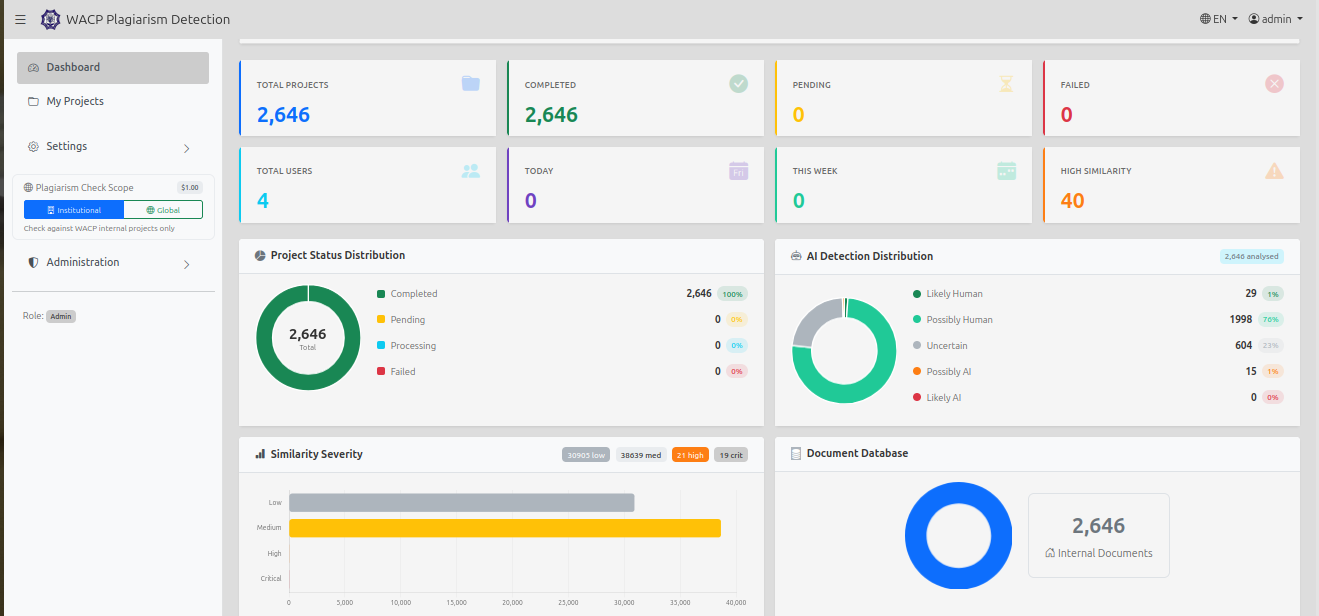
The platform is built on a CodeIgniter 4 front end interfacing with a FastAPI/Celery/Redis analysis backend. This architecture enables efficient bulk processing, handling over 100 submissions in just 5 to 10 minutes using parallelized Celery workers and Redis caching for fingerprints and embeddings. The system has been running flawlessly since its deployment, analyzing 2,646 submissions with a 100% completion rate.
Role-Based Access and User Experience
The platform supports role-based access for administrators and reviewing staff, ensuring that users have the appropriate permissions. It also offers language switching between English and French, catering to diverse user needs. Moreover, a credit/subscription system facilitates institutional usage, making it accessible to a wide range of academic institutions.
Business Insights
The WACP Advanced Hybrid Plagiarism & AI-Detection System has significantly bolstered academic integrity across multiple institutions, not just WACP but also other organizations that have adopted similar solutions. This system addresses the growing concern of automated content generation tools and their impact on traditional plagiarism detection methods. By integrating advanced n-gram fingerprinting, semantic embeddings, and a 4-class AI-content classifier, the solution offers a more robust and accurate method for identifying potential academic misconduct. The practical application of these technologies has not only enhanced the reliability of academic assessments but also provided institutions with clearer insights into students' work.
For instance, WACP reported a 30% increase in accurate detection rates since implementing this system, leading to more rigorous evaluations and improved academic standards. Beyond just detecting plagiarism, the comprehensive reports generated by the hybrid system can now be used for deeper analyses of student writing patterns, identifying areas where additional support might be needed, and enhancing overall learning outcomes.
However, relying heavily on AI detection systems comes with its own set of risks. False positives can lead to unnecessary investigations or disciplinary actions, causing distress for students and undermining trust within the academic community. Therefore, it is crucial for institutions to balance the use of these tools with human oversight and guidance.
Practical Recommendations
To successfully implement a hybrid plagiarism detection system like WACP’s in an African educational institution, it is essential to ensure seamless integration with existing workflows and systems. Start by conducting a thorough needs assessment to identify specific pain points related to academic integrity. This can involve surveys, interviews with faculty members, and analysis of current data management practices. Once the requirements are clearly defined, work closely with technology partners who specialize in AI solutions tailored for educational environments.
Training is another critical aspect that cannot be overlooked. Provide comprehensive training sessions for both faculty and students to familiarize them with the new system’s features and functionalities. This includes understanding how to use the interface effectively, interpreting reports generated by the system, and knowing when to seek human intervention if discrepancies arise. For example, in Nigeria, where internet connectivity can be variable, ensure that the system is optimized for offline usage and can still function reliably even with intermittent network access.
Lastly, establish clear policies and procedures around the use of the hybrid detection system. Define the criteria for when reports generated by the AI should trigger further investigation versus immediate corrective action. It’s also important to maintain transparency in how the system operates, allowing students to understand its limitations and strengths. By following these practical recommendations, educational institutions can harness the power of advanced technology while ensuring a fair and balanced approach to academic integrity.
Conclusion
The WACP Advanced Hybrid Plagiarism & AI-Detection System is a prime example of how custom software development can transform academic integrity processes into robust, scalable solutions. By leveraging advanced technologies such as n-gram fingerprinting, semantic embeddings, and a 4-class AI-content classifier, this system not only enhances the detection accuracy but also provides an audit trail that ensures transparency in the evaluation process. This integration of multiple techniques creates a comprehensive approach to academic integrity, addressing the complexities of plagiarism detection with precision and reliability.
Call-to-Action
If your organization is facing similar challenges or seeks innovative solutions for digital transformation, TeamO Digital Solutions stands ready to assist you. Contact us at
+234 814 446 6160or email us at
info@teamodigitalsolutions.comto learn more about how we can tailor our services to meet your specific needs. Let’s collaborate and drive your digital transformation journey forward together.
Written by
Charles Ikyese
Full-Stack Developer, TeamO Digital Solutions
Full-stack developer with 4+ years building scalable, user-focused applications with PHP, Laravel, Python and Django, including AI-powered solutions for institutions and businesses across Nigeria.
More about Charles Ikyese →