How TeamO Built Hospital Management System: Records Digitalisation in Practice
 By Charles Ikyese
September 11, 2026
5 min read
By Charles Ikyese
September 11, 2026
5 min read
Transforming Decades of Paper Records into a Digital Legacy
The Veterinary Teaching Hospital at the Faculty of Veterinary Medicine, University of Ibadan, faced a significant challenge: decades of vital records were stored solely as physical paper files. These documents encompassed client details, animal records, case files, lab reports, and clinical notes spanning from 1977 to 2021. While these records held invaluable information, they posed numerous challenges—slowness in retrieval, risks of loss or damage, and the impossibility of comprehensive search and analysis.
The Problem
At the core of this challenge was a complex array of historical records that were difficult to manage efficiently. Paper files required extensive time and resources just to locate specific information, which hindered the hospital's ability to provide timely and accurate services. Additionally, the physical nature of these documents posed risks such as fire or theft, and there was no way to leverage this data for research or teaching purposes.
The Solution
To address these issues, TeamO Digital Solutions embarked on a comprehensive records digitisation project. The solution involved several key steps:
Physical Records Cleanup and Sorting
The first step was to meticulously clean up and sort the physical records. This process required detailed documentation of each file, ensuring no document was overlooked or misplaced. TeamO's team methodically went through every record, categorising them into appropriate folders for easy reference.
Scanning and Imaging
Once sorted, the next phase involved scanning these documents into digital format using high-quality imaging technology. This ensured that each page was captured with clarity, preserving all critical information without degradation. The scanned images were then stored in a structured manner, making them easily accessible via a searchable database.
Metadata Entry and Validation
To enhance the usability of these digital records, TeamO meticulously entered metadata for each document. This included essential details such as client names, dates, case descriptions, and more. Each entry was validated to ensure accuracy, reducing errors that could arise from manual data entry.
The Outcome
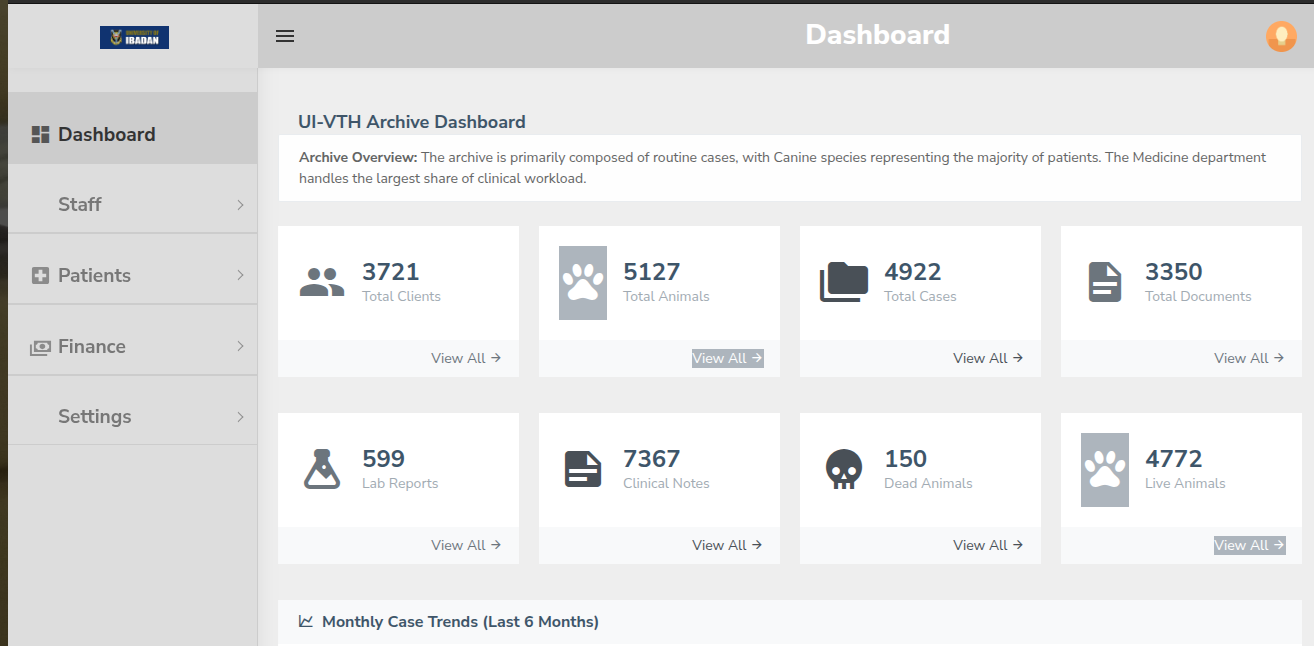
The result of this project is a robust digital archive named UI-VTH Archive, which now houses 3,721 client records, 5,127 animal records (4,772 live, 150 deceased), 4,922 case files, 3,350 documents, and 7,367 clinical notes. All of this information is searchable in seconds, providing unprecedented access to critical data for teaching, research, and clinical services.
The completed system not only enhances the hospital's operational efficiency but also ensures that sensitive patient and animal records remain securely within the institution’s control. This digital transformation has made a significant impact on the Veterinary Teaching Hospital, supporting its continued mission of providing top-tier veterinary care, education, and research.
Business Insights
The successful implementation of the Hospital Management System at the Veterinary Teaching Hospital, Faculty of Veterinary Medicine, University of Ibadan, provided significant business insights into the transformative power of digital records management for healthcare institutions in Nigeria and Africa. Digitizing these records not only streamlined administrative processes but also enhanced the hospital’s operational efficiency and patient care.
By centralizing information within a searchable database, the hospital could access critical data swiftly, which was crucial during emergencies or when coordinating multidisciplinary treatment plans. This capability reduced turnaround times for consultations and treatments, thereby improving overall service quality.
Moreover, digitization offered the hospital a competitive edge in research and teaching. The comprehensive records allowed faculty members to conduct more rigorous studies with detailed patient histories and clinical notes. For instance, researchers could now access historical data spanning decades, enabling them to identify trends and patterns that were previously hidden within the vast repository of paper files. This increased capacity for analytical work supported both academic advancements and evidence-based policy discussions in veterinary medicine across Africa.
Practical Recommendations
To replicate the success of the Hospital Management System at other healthcare facilities, a phased approach is recommended. The first step involves conducting an audit of existing records to identify gaps and prioritize digitization efforts. For example, starting with high-frequency-use departments or critical patient information can ensure that the system’s implementation benefits from immediate use and feedback.
Adequate IT infrastructure must also be in place to support the digitization process. This includes ensuring reliable internet connectivity, secure servers, and robust backup systems to prevent data loss. For instance, implementing a local server solution, as done for the Veterinary Teaching Hospital, ensures that records remain within the institution’s control and comply with data security regulations relevant to healthcare institutions.
Lastly, continuous evaluation and feedback mechanisms should be established post-implementation. Regular updates to the system based on user feedback can improve functionality and address any emerging challenges. For example, at the Veterinary Teaching Hospital, the system was continuously refined to include features like real-time patient status updates, which greatly enhanced the hospital’s responsiveness during urgent cases.
Conclusion
The Hospital Management System project vividly illustrates how comprehensive records digitalisation can transform an institution's operational efficiency and data management capabilities. By converting decades of physical records into a searchable, on-premise database, the system not only ensures the safekeeping of valuable information but also enhances access and analysis for ongoing teaching, research, and clinical services.
This transformation underscores the importance of tailored technological solutions in addressing specific institutional needs.
With extensive experience in digitalising complex record systems, TeamO Digital Solutions offers a range of services to help businesses and institutions navigate their unique challenges with clarity and precision. Whether you need records digitisation, custom software development, or IT support, we are here to provide the expertise and guidance necessary for successful digital transformation.
Get in touch through our website or contact us at +234 814 446 6160 to discuss how we can assist your organization with its digital needs.
Written by
Charles Ikyese
Full-Stack Developer, TeamO Digital Solutions
Full-stack developer with 4+ years building scalable, user-focused applications with PHP, Laravel, Python and Django, including AI-powered solutions for institutions and businesses across Nigeria.
More about Charles Ikyese →